

In the realm of drilling operations, two prominent tools stand out: the DTH (Down-The-Hole) Drilling Hammer and the rotary drill. As a supplier of DTH Drilling Hammers, I've witnessed firsthand the unique capabilities and applications of these tools. Understanding the differences between them is crucial for making informed decisions in various drilling projects.
Working Principles
The fundamental difference between a DTH Drilling Hammer and a rotary drill lies in their working principles. A rotary drill operates by applying a rotational force to the drill bit, which cuts through the rock or soil. This rotation, combined with downward pressure, allows the bit to break and remove material. The power for rotation is typically provided by a motor at the surface, transmitted through the drill string.
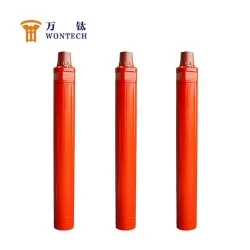
On the other hand, a DTH Drilling Hammer uses a different approach. It is a pneumatic or hydraulic tool that is placed at the bottom of the drill hole. Compressed air or hydraulic fluid is used to drive a piston inside the hammer, which repeatedly strikes the drill bit. This percussive action, combined with rotation, breaks the rock into small fragments. The debris is then removed from the hole by the air or fluid flow.
Drilling Performance
When it comes to performance, the two tools have distinct characteristics. Rotary drills are well-suited for soft to medium-hard formations. They can achieve high penetration rates in these conditions, especially when using appropriate drill bits. However, in harder rock formations, the performance of rotary drills can be significantly reduced. The cutting edges of the drill bit may wear quickly, and the torque required to rotate the bit can increase, leading to higher energy consumption.
DTH Drilling Hammers, on the other hand, excel in hard rock drilling. The percussive action of the hammer allows it to break through tough rock formations more efficiently. They can maintain relatively high penetration rates even in extremely hard rocks. Additionally, DTH hammers can drill straighter holes compared to rotary drills, which is crucial in applications where hole accuracy is important, such as in mining and construction.

Hole Diameter and Depth
The choice between a DTH Drilling Hammer and a rotary drill also depends on the required hole diameter and depth. Rotary drills are generally more versatile in terms of hole diameter. They can drill holes ranging from a few inches to several feet in diameter. This makes them suitable for a wide range of applications, including water well drilling, geothermal drilling, and large-scale construction projects.
DTH Drilling Hammers, however, are typically used for smaller to medium-sized holes. The available hole diameters for DTH hammers usually range from 3 to 12 inches. While they may not be able to drill as large a diameter as rotary drills, they can achieve greater depths. DTH hammers are often used in deep-hole drilling applications, such as in mining exploration and oil and gas wells.
Mobility and Flexibility
In terms of mobility and flexibility, rotary drills have an advantage. They can be easily transported to different locations and set up quickly. Rotary drills can also be used in various orientations, including vertical, horizontal, and inclined drilling. This makes them suitable for a wide range of drilling projects, both on-site and in remote locations.
DTH Drilling Hammers, on the other hand, require a more complex setup. They need a reliable source of compressed air or hydraulic fluid, which may require additional equipment such as compressors or pumps. However, DTH hammers can be more flexible in terms of drilling in difficult-to-reach areas. They can be used in narrow spaces or in areas with limited access, as the hammer is located at the bottom of the drill hole.
Cost Considerations
Cost is an important factor in any drilling project. Rotary drills generally have a lower initial cost compared to DTH Drilling Hammers. They are also more fuel-efficient in soft to medium-hard formations, which can result in lower operating costs. However, in hard rock formations, the wear and tear on the drill bits of rotary drills can be significant, leading to higher maintenance and replacement costs.
DTH Drilling Hammers, while having a higher initial cost, can be more cost-effective in the long run for hard rock drilling. Their ability to maintain high penetration rates in hard rocks reduces the overall drilling time, which can offset the higher initial investment. Additionally, the percussive action of the hammer reduces the wear on the drill bit, resulting in lower maintenance costs.
Applications
The different characteristics of DTH Drilling Hammers and rotary drills make them suitable for various applications. Rotary drills are commonly used in water well drilling, where the ability to drill large-diameter holes quickly is essential. They are also used in geothermal drilling, where the goal is to reach deep underground heat sources. In construction projects, rotary drills are used for foundation drilling, where accurate hole placement and large hole diameters are required.
DTH Drilling Hammers are widely used in mining exploration and production. They are used to drill blast holes in hard rock formations, which are then filled with explosives to break the rock. DTH hammers are also used in oil and gas wells, where they can drill through hard rock layers to reach the hydrocarbon reserves. In addition, DTH hammers are used in quarrying operations, where they can efficiently extract stone and other minerals.
Our DTH Drilling Hammer Products
As a supplier of DTH Drilling Hammers, we offer a wide range of products to meet the diverse needs of our customers. Our Medium Air Pressure DTH Hammer is suitable for medium-hard rock formations. It provides a good balance between performance and cost, making it a popular choice for many drilling projects.
For harder rock formations, we recommend our High Air Pressure DTH Hammer. This hammer delivers high impact energy, allowing it to break through tough rocks with ease. It is designed for high-performance drilling in challenging conditions.
In addition, we also offer Long Shank DTH Rock Drilling Tools. These tools are suitable for deep-hole drilling applications, where the length of the drill string is a critical factor. Our long shank DTH tools are designed to provide maximum stability and performance in deep holes.
Conclusion
In conclusion, the choice between a DTH Drilling Hammer and a rotary drill depends on several factors, including the type of formation, hole diameter and depth, mobility requirements, and cost considerations. While rotary drills are more versatile in terms of hole diameter and mobility, DTH Drilling Hammers excel in hard rock drilling and can achieve greater depths. As a supplier of DTH Drilling Hammers, we are committed to providing our customers with high-quality products and excellent service. If you are interested in learning more about our DTH Drilling Hammers or have any questions about your drilling project, please feel free to contact us for a detailed discussion and procurement negotiation.
References
- "Drilling Engineering Handbook" by John P. Yelland
- "Rock Drilling and Blasting" by Ove Ouchterlony
- "Mining Engineering Handbook" by Hartman and Mutmansky