

Hey there, folks! I'm a supplier of Water Well Drilling Rigs, and I've seen my fair share of challenges in the field. One of the most common headaches when drilling water wells is dealing with hard rock layers. It can turn a relatively straightforward job into a real nightmare if you're not prepared. So, in this blog, I'm gonna share some tips and tricks on how to handle those stubborn hard rock layers when using a water well drilling rig.
First off, let's talk about why hard rock layers are such a pain. Hard rocks, like granite, basalt, or quartzite, are extremely tough and dense. They can quickly wear out your drill bits, slow down the drilling process, and even cause damage to your drilling rig if you're not careful. But don't worry, there are ways to overcome these challenges.
One of the most important things is to choose the right drill bit. For hard rock layers, you'll want to go for a bit that's specifically designed to handle the tough stuff. Diamond drill bits are a popular choice because they're incredibly hard and can cut through even the hardest rocks. They work by using tiny diamond particles embedded in the bit's surface to grind away at the rock. Another option is a tungsten carbide drill bit. These bits are also very hard and can withstand the high pressures and forces involved in drilling through hard rock.
But it's not just about the type of drill bit; it's also about the size and shape. You'll need to choose a bit that's the right diameter for your well and has the appropriate cutting profile for the type of rock you're dealing with. For example, if you're drilling through a very hard, brittle rock, a bit with a sharp, pointed tip might work best. On the other hand, if the rock is more abrasive, a bit with a more rounded cutting edge might be a better choice.

Once you've got the right drill bit, you need to make sure you're using the right drilling parameters. This includes things like the rotation speed, the feed rate, and the amount of weight on the bit. When drilling through hard rock, you'll generally want to use a slower rotation speed and a higher feed rate. This helps to prevent the bit from overheating and wearing out too quickly. You'll also need to apply enough weight on the bit to keep it in contact with the rock and ensure a good cutting action. But be careful not to apply too much weight, as this can cause the bit to break or the rig to become unstable.
In addition to choosing the right drill bit and drilling parameters, you can also use some other techniques to make the drilling process easier. One of these is to use a drilling fluid. Drilling fluids, also known as drilling muds, are used to cool the drill bit, remove the cuttings from the wellbore, and provide support to the walls of the well. They can also help to reduce the friction between the bit and the rock, which can make it easier to drill through hard layers. There are different types of drilling fluids available, depending on the type of rock and the drilling conditions. For example, water-based drilling fluids are commonly used for general drilling applications, while oil-based drilling fluids are often used for drilling through very hard or abrasive rocks.
Another technique is to use a down-the-hole (DTH) hammer. A DTH hammer is a percussion drill that uses compressed air to drive a piston inside the hammer, which in turn strikes the drill bit. This creates a high-impact force that can break through hard rock layers more effectively than a rotary drill. DTH hammers are particularly useful for drilling through hard, dense rocks, and they can significantly increase the drilling speed and efficiency.
Now, let's talk about some of the equipment we offer at our company. We have a wide range of water well drilling rigs that are suitable for different types of drilling applications, including drilling through hard rock layers. For example, our Vehicle Mounted Water Drilling Machines are designed for easy transportation and mobility, making them ideal for drilling in remote locations. They're also equipped with powerful engines and advanced drilling systems that can handle the toughest drilling conditions.
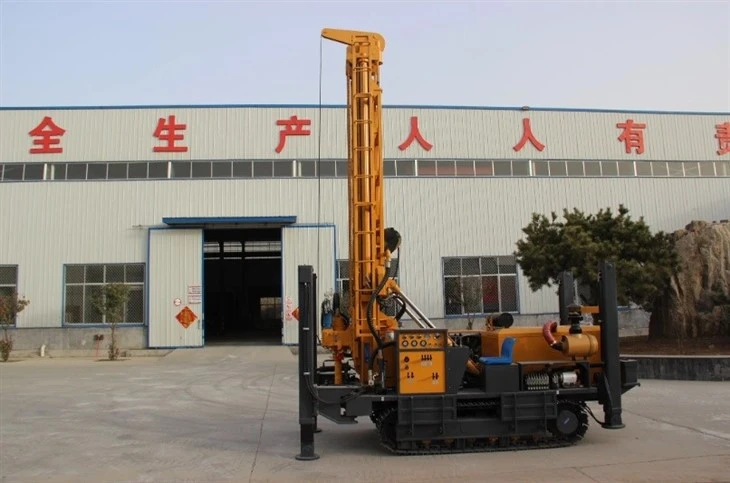
If you're looking for a rig that can drill to greater depths, our 500m Depth Crawler Water Well Drilling Rig might be the right choice for you. This rig is mounted on a crawler chassis, which provides excellent stability and traction on uneven terrain. It's also equipped with a high-capacity mud pump and a powerful drill head that can handle the high pressures and forces involved in drilling to great depths.
For those who need a more compact and versatile rig, our 280m Depth Truck Mounted Borehole Water Well Drilling Rig is a great option. This rig is mounted on a truck, which makes it easy to transport and maneuver in urban or suburban areas. It's also equipped with a state-of-the-art control system that allows for precise drilling and easy operation.
In conclusion, dealing with hard rock layers when using a water well drilling rig can be a challenge, but it's definitely not impossible. By choosing the right drill bit, using the right drilling parameters, and applying some of the techniques I've mentioned, you can overcome these challenges and get the job done efficiently and effectively. And if you're in the market for a water well drilling rig, be sure to check out our range of products. We're committed to providing high-quality equipment and excellent customer service, and we're always happy to help you find the right rig for your needs. So, if you have any questions or would like to discuss your drilling requirements, don't hesitate to get in touch. We look forward to hearing from you and helping you with your water well drilling projects.
References
- Drilling Engineering Handbook, various authors
- Water Well Drilling Best Practices Guide, industry experts